
Fall Sale
LIMITED-TIME OFFER
Ends November 29 at 11:59 PM

Hi-Hog
SKU:HH-1336
Couldn't load pickup availability
Starting at $0.22/mo with approved credit.
Financing
Freight Charge
This item may require freight charges due to the weight or size. Our friendly staff will contact you to set up your delivery. If you have any questions please Contact Us or call 512-264-2024.
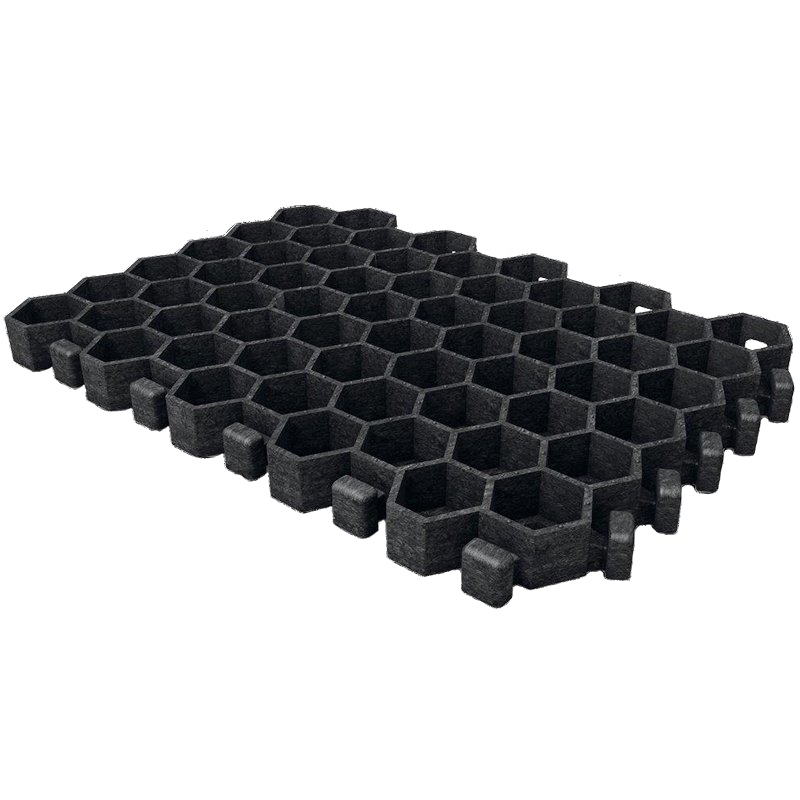
This multi-purpose porous tile has a wide range of uses for a wide range of industries. The grid's three most significant features are its permeability, load-bearing strength, and ability to link with other tiles to create a smooth, continuous grid. While the manufacturer refers to this product as a Paddock Slab, its functionality is certainly not limited to the paddock.
Sold in quantities of 156 pieces.
Permeable ground stabilizing tiles
Equine facilities use Paddock Slabs as part of a superior footing solution. Cattle producers use it to prevent mud around water stations, gates, handling facilities and high traffic areas. Landscapers use it to create load bearing surfaces that are also permeable and guard against erosion. Architects use it as part of a green design for both it's aesthetics and its ability to hold materials in place and control erosion.
loading class SLW 60 according to DIN 1072 with a max. wheel load of 100kN
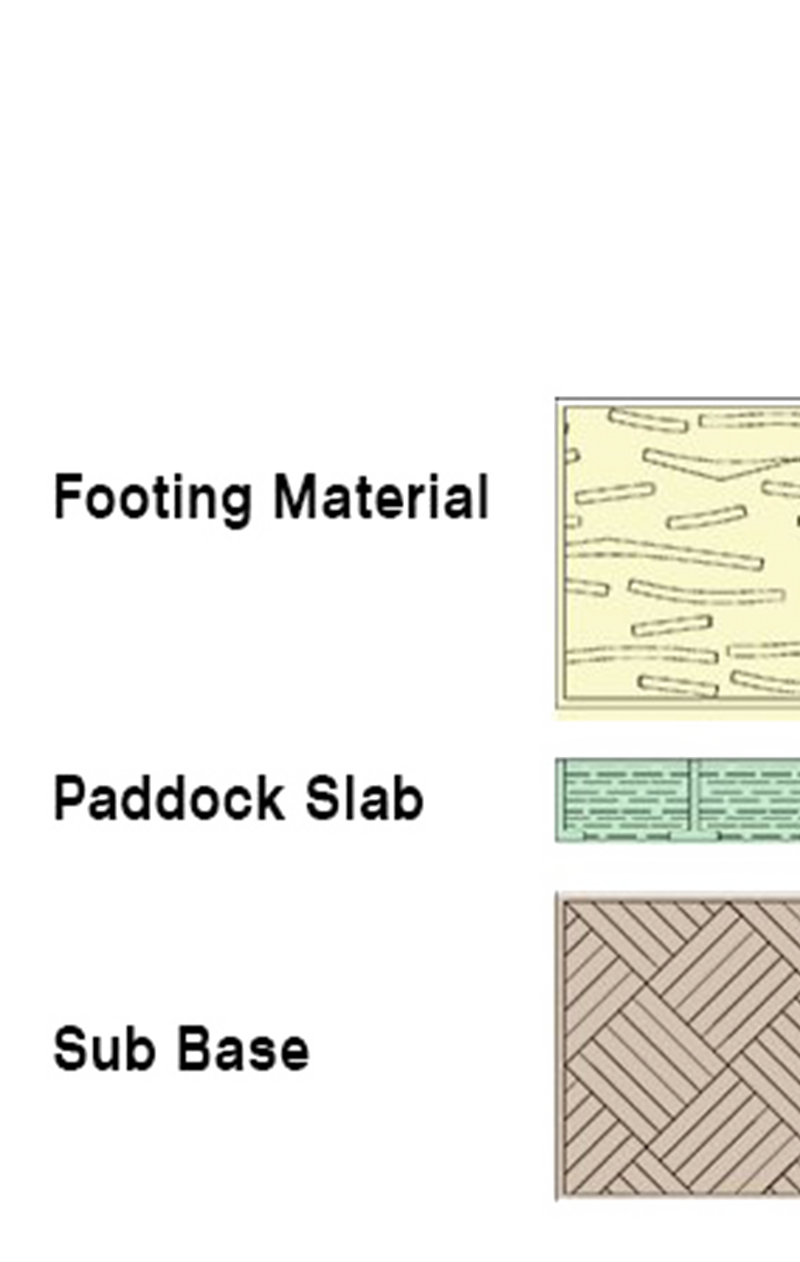
The Paddock Slab grid system is laid directly on the natural soil: just remove the top layer (turf or mud) and grade a slope between 1% and 2%. This installation is designed for those looking for good footing with a minimal amount of site labor. Not recommended for sites with poor drainage
NOTE: When you lay Paddock Slab directly on the sub-base (existing ground) the surface drainage will not improve beyond the capacity of the grid installation. If the existing ground is water-permeable, the surface water will continue to drain away. If the ground is limey or clayey, through which surface water could not drain away beforehand, surface water will not be able to drain away after installation either. The water will simply fill the grid. If the volume of water exceeds the capacity of the grid the surface footing will be affected.
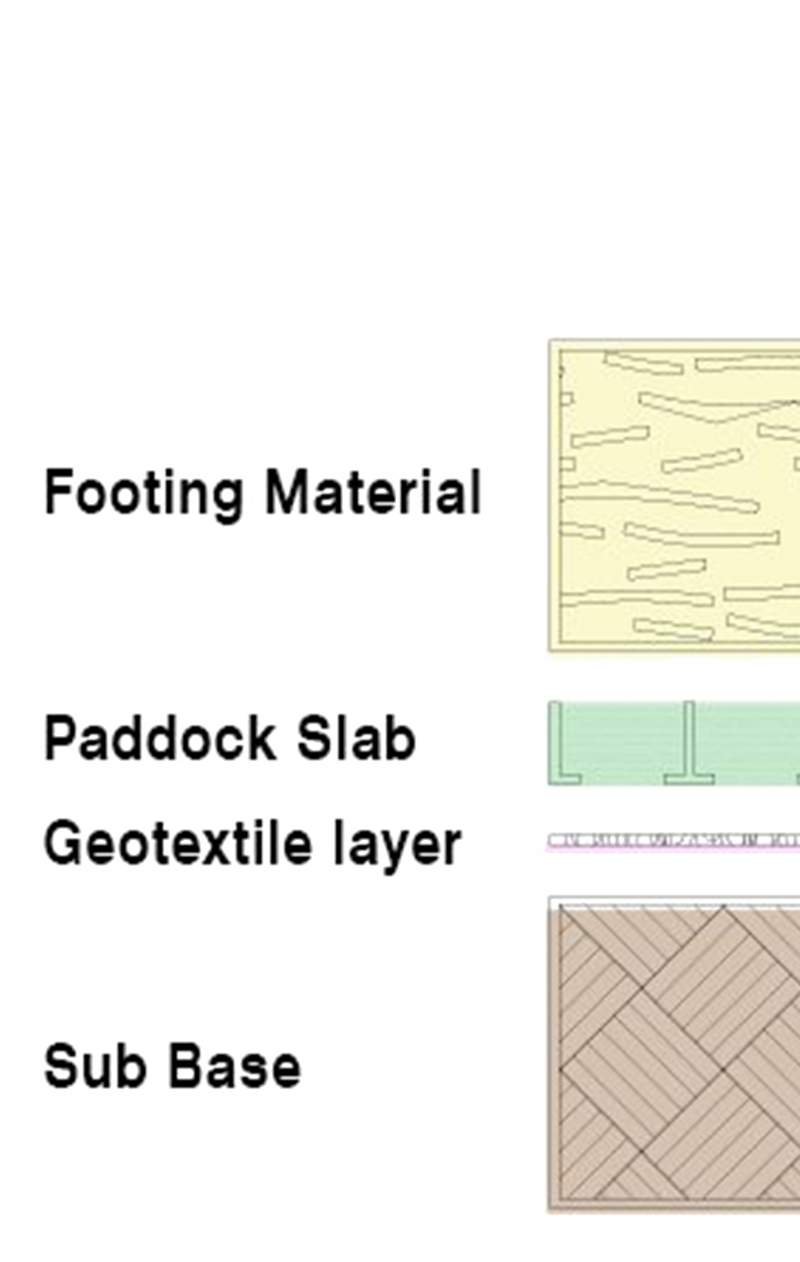
The Simple Slab + is the same as the previous design with the addition of a geosynthetic textile layer. The geosynthetic textile layer allows water to flow down into the ground without allowing surface materials to be pushed into the soil, or soil elements to percolate up into the leveling layer or footing.
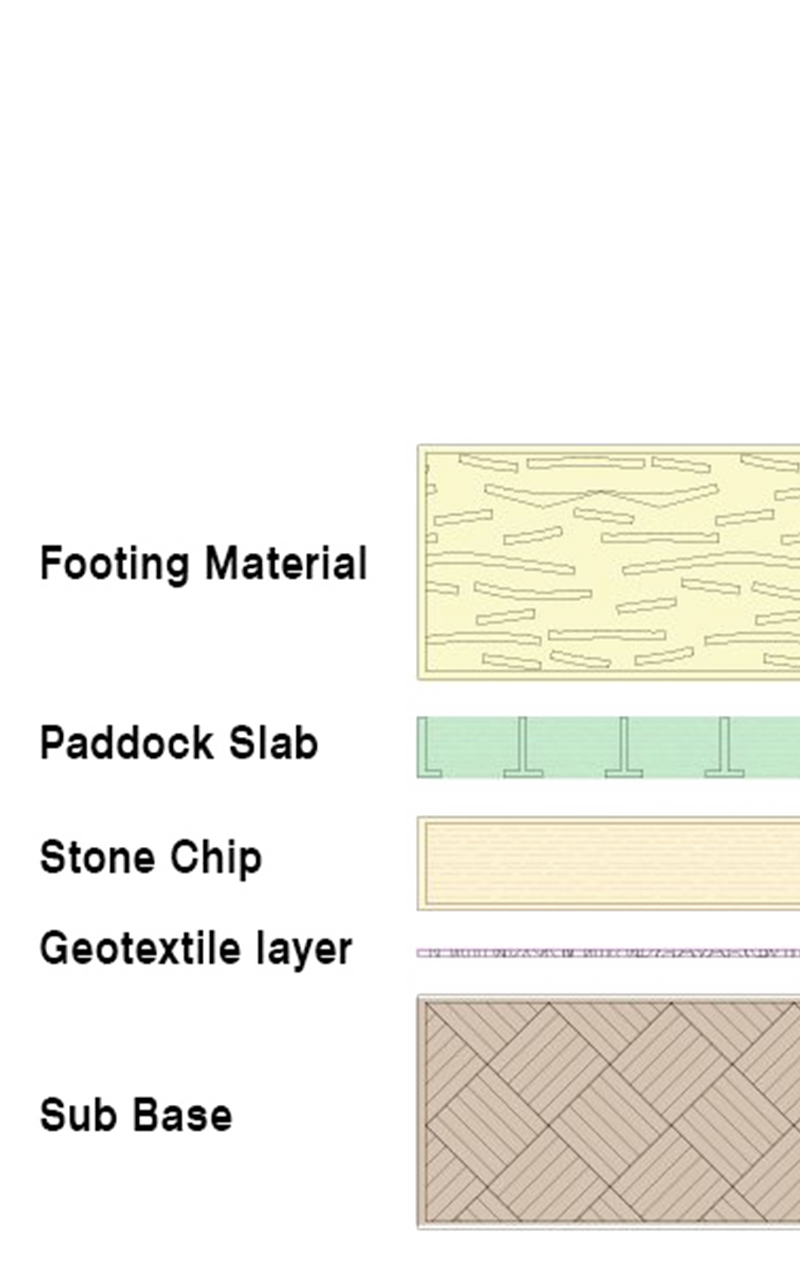
This footing adds a 3 to 5 cm leveling layer of stone chips. The leveling layer ensures that the Paddock Slab layer, and the subsequent footing layer, is level. It is best if a laser level is used to assist in its installation. This layer should be compacted with a roller or plate vibrator. In addition to providing a superior base this layer will also contribute to the ability to manage rain or storm water.
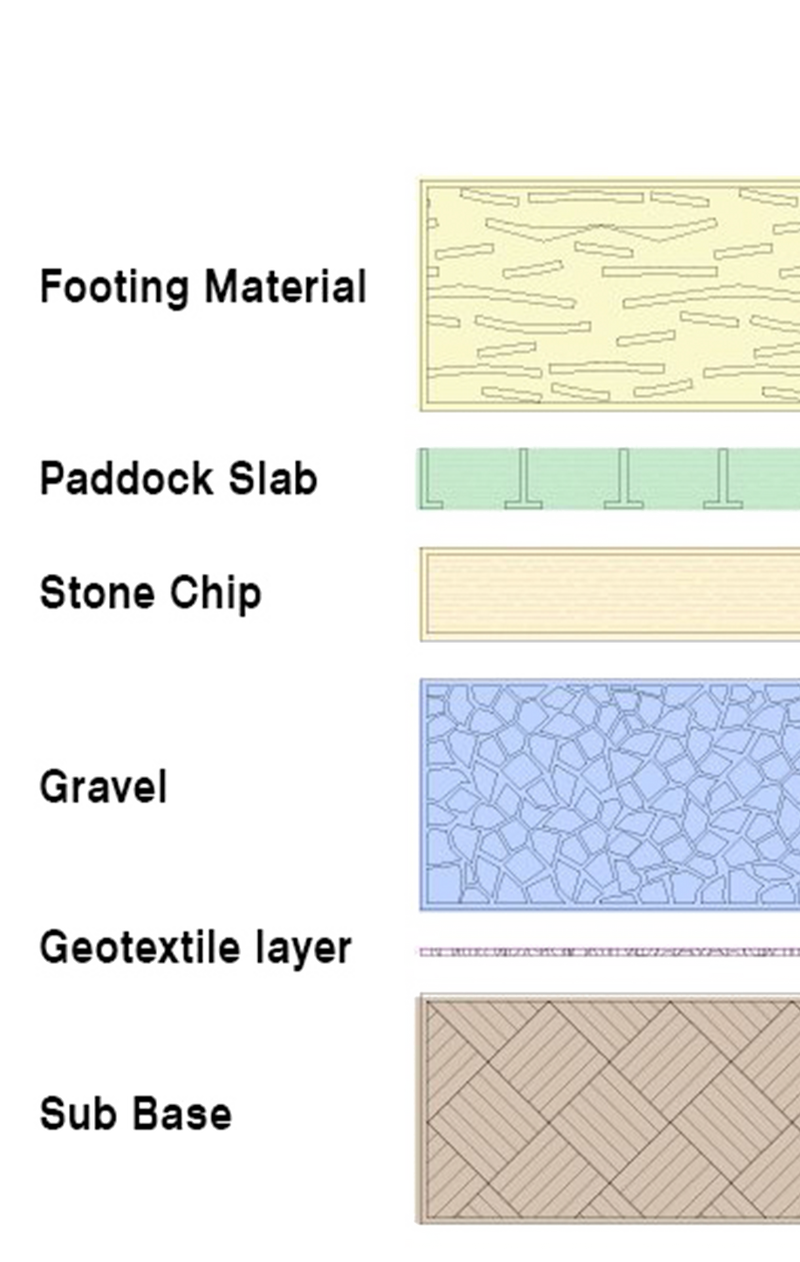
This footing adds a 10 to 25 cm base layer of broken stone or gravel. The thicker this layer is, the better it will drain and ensure that your footing can be consistently maintained. The leveling layer above does not need to be as thick as described in the Horseman footing. The gravel layer can be roughly leveled as the leveling layer should provide the level that you require before installing the Paddock Slab.
Paddock Slabs solve your footing challenges by providing outstanding support for both your animals and the footing material itself. Additionally, Paddock Slabs act as a barrier, separating your footing material layer from the foundation materials below. This ensures that your valuable footing materials are not prematurely contaminated with gravel and dirt.
The perforated Paddock Slab also allows for excellent drainage to ensure that your footing materials do not become waterlogged. And because Paddock Slab supports the vehicles, people and animals that traverse it, the foundation materials will remain uncompressed and porous allowing for continued superior drainage.
A good base foundation will provide firm support and effective drainage. The depth of this base depends on what the arena will be used for and how much water the facility may need to absorb. the base should be graded so that water will not pool.
Firmness: While dressage events are good with a base of 4 to 6 inches in depth, jumping events need a deeper 12” base to provide a firm surface for the horses to generate power.
Drainage: Each of the three base layers, Paddock Slab, Stone Chips, and Gravel, are designed to provide both a firm consistent footing foundation and a porous substrate capable of shedding water from the arena. Recommend the use of 1 to 2” of sub-angular particles for the leveling layer as a good balance between stability and porosity.
Level: While the arena should have a slight grade of 1 to 2% to ensure proper drainage, it is important that the foundation is smooth and on the same plane.
If installed correctly the horse and rider can expect to enjoy consistent quality footing anywhere in the arena. This will result in increased confidence and performance while maintaining equine soundness.
There are several methods of installing your Paddock Slab. Select your method based on your footing goals.
A brief description of the component footing layers:
NOTE: The size and shape of the particles being used will affect the ability of the resulting footing to provide traction and absorption. Round particles of a consistent size will offer little traction and will need to be deep to absorb the energy of the horse and rider. Sharp angular particles of a wide range of sizes will offer lots of traction but will compact quickly and not offer sufficient absorption. Sub-angular particles of similar size offer the best option.
If all of these elements are taken into consideration the horse and rider can expect to enjoy consistent quality footing anywhere in the arena. This will result in increased confidence and performance while maintaining equine soundness.
A successful arena surface is no better than the underlying foundation. With Paddock Slab’s exceptional combination of structural support and porosity your footing is ready to shine.